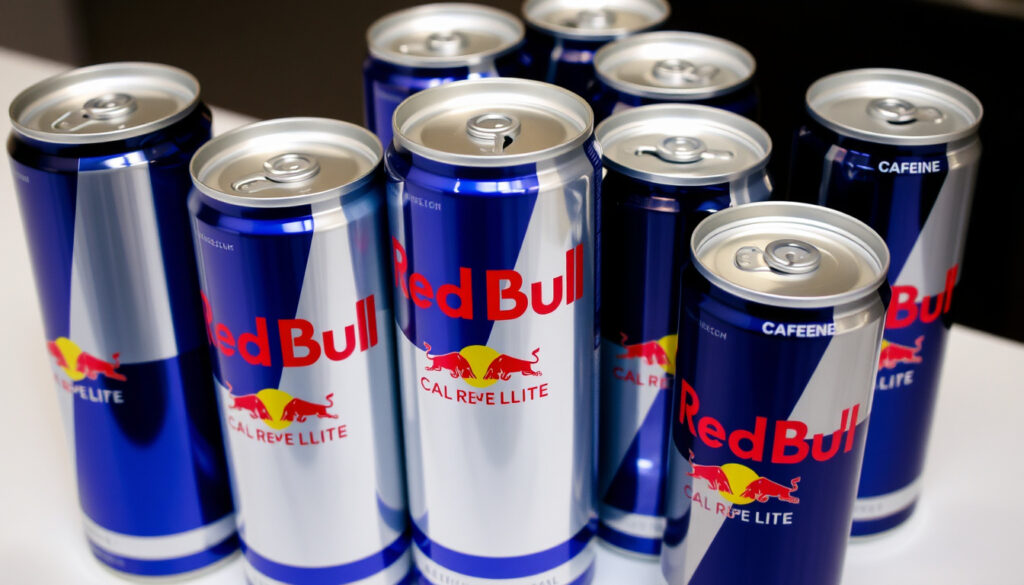
How Much Caffeine in Red Bull? All Can Sizes
You know the feeling: it’s mid-afternoon, your energy dips, and a can of Red Bull sounds like the quickest fix. But how much caffeine are you actually getting with each sip? A standard 8.4 fl oz (250 ml) can contains exactly 80 mg of caffeine, according to Red Bull’s official site — about the same as a cup of home-brewed coffee. Let’s walk through every common size and how they stack against the safe daily limits set by health authorities.
Caffeine in 250 ml: 80 mg ·
Caffeine in 355 ml: 114 mg ·
Caffeine in 473 ml: 151 mg ·
Caffeine per 100 ml: 32 mg
Quick snapshot
- 250 ml (8.4 fl oz) — data from Red Bull (official manufacturer)
- 80 mg caffeine — Red Bull (Red Bull (official manufacturer))
- Same caffeine as home-brewed coffee — noted by Driftaway Coffee (specialty coffee retailer)
- 355 ml (12 fl oz) — Red Bull (Insider Food (media outlet))
- 114 mg caffeine — Red Bull (Insider Food (media outlet))
- Common vending-machine size in the US — Insider Food (media outlet)
- 473 ml (16 fl oz) — Red Bull (Caffeine Informer (independent caffeine database))
- 151 mg caffeine — Red Bull (Caffeine Informer (independent caffeine database))
- Above average caffeine for energy drinks — Caffeine Informer (independent caffeine database)
- 500 ml (16.9 fl oz) — approximate, derived from official per-100 ml data — Caffeine Informer (U.S. Food and Drug Administration (federal health regulator))
- ~160 mg caffeine (calculated) — Caffeine Informer (U.S. Food and Drug Administration (federal health regulator))
- Less than half the FDA daily limit for healthy adults — U.S. Food and Drug Administration (federal health regulator)
The pattern is consistent across all Red Bull sizes: the larger the can, the more caffeine, but the concentration stays at 32 mg per 100 ml.
| Volume | Caffeine | Mg per 100 ml |
|---|---|---|
| 250 ml (8.4 fl oz) | 80 mg | 32 mg |
| 330 ml (11.2 fl oz) | ~106 mg (calculated) | 32 mg |
| 355 ml (12 fl oz) | 114 mg | 32 mg |
| 473 ml (16 fl oz) | 151 mg | 32 mg |
| 500 ml (16.9 fl oz) | ~160 mg (calculated) | 32 mg |
| Per 100 ml | 32 mg | 32 mg |
How much caffeine is in a 250 ml Red Bull?
Caffeine content in standard 8.4 fl oz can
- Exactly 80 mg of caffeine — Red Bull
- That equals 32 mg per 100 ml — consistent across sizes.
This is the most familiar Red Bull size in the UK and much of Europe. It’s often the baseline for comparisons: 80 mg is moderate — roughly one-third of the 200 mg single-dose limit that the FDA, EFSA, and Health Canada consider safe for healthy adults.
A single can won’t push most people close to any safety threshold, but stacking multiple cans throughout a day can add up quickly.
Comparison to a cup of coffee
A standard 8-oz cup of drip coffee contains roughly 80–100 mg of caffeine, according to Driftaway Coffee. That puts Red Bull and a regular morning coffee on nearly equal footing — about the same jolt per serving. The difference? Coffee comes with antioxidants; Red Bull adds sugar, taurine, and B vitamins.
The catch: If you drink a large coffee (16 oz), you’re getting 160–200 mg of caffeine — more than two standard Red Bulls in one go.
How much caffeine is in a 330 ml Red Bull?
Caffeine in 330 ml vs 250 ml
- 330 ml contains approximately 106 mg of caffeine, based on the consistent 32 mg per 100 ml — Caffeine Informer.
- That’s about 33% more caffeine than the standard 250 ml can.
This size is less common in the US but appears in some international markets and multipacks. It’s a middle ground — roughly the same caffeine as a small Americano.
Why this matters: If you grab a 330 ml can thinking it’s the same as the standard 250 ml, you’re getting an extra 26 mg of caffeine — about one-third more. For sensitive individuals, that difference can tip from comfortable to jittery.
Caffeine per 100 ml derived value
| Size | Caffeine per 100 ml |
|---|---|
| All Red Bull varieties | 32 mg |
The density is what makes predictions easy: multiply the total volume in ml by 0.32 to get the approximate caffeine content. This works across all sizes because Red Bull’s recipe is standardized. The takeaway: Red Bull’s caffeine density is constant, so the trade-off is simply volume.
How much caffeine is in a 500 ml Red Bull?
Caffeine in large cans
- ~160 mg of caffeine per 500 ml (calculated from 32 mg/100 ml) — Caffeine Informer.
- This is the largest standard single serving before you reach the 20 fl oz (591 ml) can sold in some markets, which contains 198 mg — Red Bull.
A 500 ml can delivers about 40% of the FDA’s 400 mg daily limit. That’s still well within the safe zone for a single serving, but it’s a significant caffeine load — equivalent to two standard coffees.
Someone who drinks a 500 ml Red Bull in the morning may still have room for another caffeine source later, but adding a second large energy drink or several coffees can quickly hit or exceed the 400 mg ceiling.
The takeaway: A 500 ml Red Bull provides 160 mg of caffeine, which is 40% of the FDA daily limit. For most healthy adults, this is a safe single-serving dose, but it’s easy to accumulate from other sources.
Comparison to daily recommended limit
The FDA advises that healthy adults can generally consume up to 400 mg of caffeine per day without negative effects. Here’s how Red Bull sizes stack up against that threshold:
- 250 ml (80 mg) = 20% of daily limit
- 473 ml (151 mg) = 38% of daily limit
- 500 ml (~160 mg) = 40% of daily limit
- 591 ml (198 mg) = 49.5% of daily limit
The implication: Even the largest single can leaves more than half your daily caffeine budget untouched — so Red Bull alone is rarely the culprit in caffeine overconsumption. The problem is mixing it with coffee, tea, and other caffeinated products.
How much caffeine in Red Bull vs coffee?
Caffeine in drip coffee vs Red Bull
One 8-oz cup of drip coffee (80–100 mg) and one 250 ml Red Bull (80 mg) are essentially caffeine equivalents. But coffee servings are often larger: a 12-oz coffee from a cafe can pack 120–150 mg, surpassing a 355 ml Red Bull (114 mg). Driftaway Coffee confirms that coffee generally delivers more caffeine per typical serving because people tend to drink more volume.
Caffeine in espresso vs Red Bull
A single shot of espresso contains about 63 mg of caffeine — less than a 250 ml Red Bull. But espresso is rarely consumed alone; a latte or Americano with two shots delivers 126 mg, which is more than a 355 ml Red Bull (114 mg) and close to a 473 ml can (151 mg).
The trade-off: Red Bull gives you a predictable, consistent dose per can, while coffee’s caffeine content varies widely by brewing method, bean type, and serving size. If you want precision, Red Bull wins. If you want to control your intake more flexibly, coffee gives you that option.
For a similar analysis of another popular beverage, see our article on Is Guinness Good for You – Nutrition Facts, Benefits and Risks.
Is 200 mg of caffeine high? Is 400 mg or 500 mg too much?
FDA guidelines on daily caffeine intake
- 200 mg is considered a moderate single dose — safe for most healthy adults, per FDA guidance.
- 400 mg per day is the ceiling the FDA recommends avoiding to prevent negative effects.
- 500 mg is above that ceiling for many — around 25% of people may experience side effects like insomnia, jitters, or increased heart rate at this level, according to The FDA.
Individual sensitivity varies widely. Some people can handle 600 mg daily without issue; others feel wired after 100 mg. The FDA notes that tolerance is influenced by genetics, body weight, and medication use.
The takeaway: The FDA considers 200 mg a moderate single dose and 400 mg the daily ceiling. Red Bull alone rarely causes overconsumption, but combining with coffee or other caffeinated drinks can push you over the limit.
Symptoms of excessive caffeine consumption
- Restlessness, anxiety, insomnia
- Rapid heart rate, palpitations
- Upset stomach, nausea
- Warnings from The FDA also mention that consuming around 1,200 mg can produce toxic effects like convulsions.
Why this matters: Two large Red Bulls (473 ml each) reach 302 mg — well under the 400 mg limit. Four standard cans would hit 320 mg. It’s hard to overdo it with Red Bull alone, but mixing sources is where risk grows.
For most healthy adults, Red Bull in moderation poses no safety concerns. The real trap is the additive effect when energy drinks are layered with coffee, tea, and soda throughout the day.
What’s confirmed and what’s unclear
Confirmed facts
- 250 ml can contains 80 mg caffeine — Red Bull
- 355 ml can contains 114 mg caffeine — Red Bull
- 473 ml can contains 151 mg caffeine — Red Bull
- FDA states 400 mg per day is safe for healthy adults
- 20 fl oz can contains 198 mg caffeine — Red Bull
- Per 100 ml, Red Bull has 32 mg caffeine (derived from official data)
What’s unclear
- Exact caffeine content of 330 ml can is not published by Red Bull — derived value ~106 mg.
- Individual sensitivity thresholds vary; some people may experience side effects below 400 mg.
- Coffee caffeine comparisons are estimates because coffee strength varies by brew.
- The 20 fl oz can caffeine content (198 mg) is confirmed by Red Bull but not verified across all markets.
- Healthline’s statement about moderate intake is general and may not apply equally to all populations.
- The exact threshold for side effects varies per individual, making 400 mg safe for most but not all.
Quotes from authorities
“One 8.4 fl oz can of Red Bull contains 80 mg of caffeine — about the same as a cup of coffee.”
“Healthy adults can generally consume up to 400 mg of caffeine per day without negative effects.”
U.S. Food and Drug Administration (federal health regulator)
“Moderate intake has no severe side effects, but high doses may affect heart rate and blood pressure.”
Healthline (medical information publisher)
The editorial view: Healthline’s observation points to the dose-dependent nature of caffeine. For Red Bull drinkers, staying at or below 400 mg per day — about two 473 ml cans — keeps most people in the safe zone.
The article on caffeine amounts in Red Bull explains how much caffeine is in each Red Bull can size.
Frequently asked questions
Does Red Bull have more caffeine than Monster?
No. Monster Energy contains 160 mg per 16 fl oz (473 ml) can, compared to Red Bull’s 151 mg for the same size. The difference is minimal — about 5%. Both are close to the 400 mg daily limit if consumed in multiples.
Is Red Bull safe for teenagers?
The American Academy of Pediatrics advises that adolescents consume no more than 100 mg of caffeine per day. A standard 250 ml Red Bull (80 mg) fits within that limit, but larger cans exceed it. Parents should monitor total intake from all sources.
Can I drink Red Bull while pregnant?
The FDA recommends that pregnant women consult a health professional for personalized caffeine guidance. General guidelines suggest limiting to 200 mg per day — which means a single 250 ml Red Bull (80 mg) is likely safe, but a 473 ml can (151 mg) leaves little room for other caffeine.
How long does the caffeine effect of Red Bull last?
Peak caffeine concentration in the blood occurs about 30–60 minutes after consumption, and the half-life is roughly 3–5 hours for most adults. The energizing effect typically lasts 4–6 hours, though individual metabolism varies.
Does Red Bull sugar free have less caffeine?
No. Red Bull Sugar Free and Red Bull Zero contain the same 80 mg of caffeine per 250 ml can — the caffeine content is unchanged. The only difference is the sweetener and calorie count (10 calories per can versus 110 in the original).
Is it okay to drink Red Bull before exercise?
Moderate caffeine intake before exercise can improve focus and performance, but consuming more than 200 mg per dose may cause dehydration or heart palpitations during high-intensity workouts. A single 250 ml Red Bull (80 mg) is considered safe for most athletes.
How much caffeine is in a 355 ml Red Bull?
A 355 ml (12 fl oz) can contains 114 mg of caffeine, as stated by Red Bull’s official website. That’s about 42% of the daily FDA limit for a single serving.
For anyone regularly drinking Red Bull in the US, the choice is clear: keep it to one standard can (80 mg) if you’re sensitive, or up to four smaller cans (320 mg) if you know your tolerance — but always stay under the 400 mg ceiling set by federal regulators, or risk side effects that can ruin your day.
Meer gerelateerde berichten
 King of Staten Island: True Story, Cast, Reviews
 Rachel Bilson: Relationships, Career, and Life Now
 Japanese Restaurant Near Me – Top Rated Spots in PA
 Pets for Homes UK: Top Adoption Sites & Safety Tips
 Al-Nassr vs Al Kholood: H2H, Results & Predictions
 Frankie Dettori’s Bankruptcy: Career and Life Today
 Community Fibre Contact Number: Phone, Live Chat & Hours
 Which Oil for My Car? Find by Registration & Viscosity