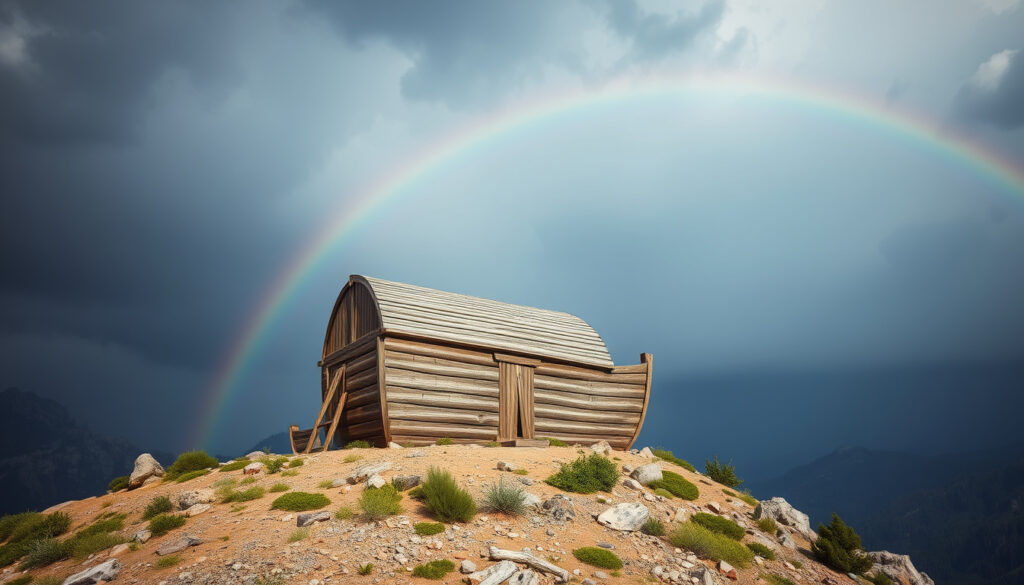
Noah’s Ark: Location, Story, Evidence, and Biblical Facts
Few stories have sailed through the centuries as steadily as Noah’s Ark, whether first heard in Sunday school or seen in a Hollywood epic. This guide separates what the Bible says from archaeological claims and pop-culture replicas.
Length: 510 feet (155 meters) ·
Width: 85 feet (26 meters) ·
Height: 51 feet (15.5 meters) ·
Number of decks: 3 ·
Human passengers: 8 (Noah and his family) ·
Traditional resting place: Mount Ararat, Turkey
Quick snapshot
- Biblical dimensions: 300 cubits long, 50 cubits wide, 30 cubits high (BibleHub – Genesis 6:15)
- Ark Encounter replica built to 510 ft using a royal cubit (Ark Encounter – size estimate)
- Traditional landing site: mountains of Ararat, Turkey (CreationWiki – location)
- Exact location of the ark remains unconfirmed (Popular Mechanics – no confirmation)
- Historical truth of a global flood is debated by scholars (Popular Mechanics – no confirmation)
- Durupınar formation shows marine deposits but not a ship (New York Post – soil analysis)
- Flood lasts 40 days and 40 nights (BibleHub – Genesis 7:12) (BibleHub – Genesis 8:4)
- Ark rests on Mount Ararat; covenant with rainbow (BibleHub – Genesis 8:4, Genesis 9:13)
- New research at Durupınar using ground-penetrating radar and drilling (Türkiye Today – study underway)
- Ark Encounter continues to draw millions of visitors (Türkiye Today – study underway)
- Academic consensus remains skeptical of physical evidence (Türkiye Today – study underway)
The biblical dimensions alone tell a story. Seven rows of data crystallize what the ark was supposed to be — and what it would take to build it today.
| Attribute | Value |
|---|---|
| Length | 510 feet (155 meters) |
| Width | 85 feet (26 meters) |
| Height | 51 feet (15.5 meters) |
| Material | Gopher wood (likely cedar or cypress) |
| Builder | Noah, at God’s command |
| Passengers | 8 humans, male and female of every animal kind |
| Traditional resting place | Mount Ararat, Turkey |
The pattern: these numbers come from a single ancient text, not from archaeological discovery. The gap between what the Bible describes and what science can verify is the core tension of the whole story.
Where is Noah’s ark located?
Traditional resting place: Mount Ararat
- Genesis 8:4 states the ark came to rest on the “mountains of Ararat” (BibleHub – Genesis 8:4)
- Mount Ararat (Ağrı Dağı) is a 5,137-meter volcanic peak in eastern Turkey
- Centuries of expeditions have reported sightings but no confirmed remains
Mount Ararat is the most famous candidate, yet every claimed discovery there has fallen apart under scrutiny. The mountain itself is sacred — but empty.
Modern replica: Ark Encounter in Kentucky
- A full-size wooden ark built to the dimensions of 300 cubits by 50 cubits by 30 cubits (Ark Encounter – official site)
- Located in Williamstown, Kentucky, opened in 2016
- Uses a royal cubit of about 20.4 inches, resulting in a 510-foot vessel
Durupınar site in Turkey
- A boat-shaped formation in Doğubayazıt, about 29 km south of Mount Ararat (The Jerusalem Post – location details)
- Ground-penetrating radar revealed angular structures and a 13-meter tunnel (The Jerusalem Post – radar findings)
- Soil samples contained clay, marine deposits, and seafood remnants (New York Post – soil analysis)
- Researchers caution they cannot say the ark itself is at the site (Popular Mechanics – team’s warning)
The catch: each location comes with a different kind of evidence — biblical tradition, modern tourism, or geological anomaly — but none has produced a single plank of gopher wood.
Is Noah’s ark a true story?
Biblical account vs. historical evidence
- Most mainstream historians and archaeologists consider the global flood a myth (Wikipedia – scholarly consensus)
- No geological evidence of a worldwide flood within human history exists
- The story shares parallels with older Mesopotamian flood myths (e.g., Epic of Gilgamesh)
Do Catholics believe Noah’s ark was real?
- The Catholic Church teaches that the ark is a historical event, not merely allegory
- The Catechism of the Catholic Church (paragraph 1219) references the ark as a prefiguration of baptism
- Pope Francis has spoken of Noah as a real figure, but the Church allows for metaphorical interpretation of some details
Has any evidence been found?
- No conclusive physical evidence of the ark has been discovered (Popular Mechanics – no confirmation)
- The Durupınar formation remains the most promising candidate, but geologists often interpret it as a natural rock formation
- Carbon dating of materials from the site has not been peer-reviewed in major journals
For millions of believers, the ark’s historicity is a matter of faith. For the scientific community, the lack of evidence is a closed case. The two sides are not talking past each other — they are working from fundamentally different standards of proof.
The implication: the historical debate remains unsettled, with each side anchored in its own evidentiary framework.
What animal did God not let on Noah’s ark?
The question of clean vs. unclean animals
- Genesis 7:2 commands: “Take with you seven pairs of every clean animal, and one pair of every unclean animal” (BibleHub – Genesis 7:2)
- Clean animals were those suitable for sacrifice and later for eating; unclean were not
- All kinds of land animals were represented — none were completely excluded
Which animals were excluded?
- Fish and aquatic creatures: they could survive the flood outside the ark
- Insects: not explicitly mentioned in the passenger list (some interpretations include them)
- Plants: not carried on the ark (they would regenerate from seeds or surviving vegetation)
Interpretations in Jewish and Christian traditions
- Jewish tradition counts 7 pairs of clean animals, 1 pair of unclean, totaling many more than “two of every kind”
- Some Christian commentators argue that the phrase “every living thing” (Genesis 6:19) covers all land animals, including insects
- The exact number of animal species on the ark is debated; conservative estimates range from 16,000 to 50,000 individual animals
The trade-off: the more animals you include, the more miraculous the logistics become. The answer to “what animal was left out” is essentially — nothing that couldn’t swim or fly.
Was the Titanic bigger than Noah’s ark?
Three key numbers, one clear winner: the Titanic was longer, taller, and heavier, but the ark had a wider beam relative to its length.
| Dimension | Noah’s Ark (biblical estimate) | Titanic |
|---|---|---|
| Length | 510 ft (155 m) | 882 ft (269 m) |
| Width (beam) | 85 ft (26 m) | 92 ft (28 m) |
| Height | 51 ft (15.5 m) | 175 ft (53 m, keel to top of funnels) |
| Displacement | ~20,000 tons (estimated) | 52,310 tons |
| Passenger capacity | 8 humans + animals | 2,453 passengers + 903 crew |
- Titanic was 372 ft longer, 7 ft wider, and 124 ft taller than the ark (Ark Encounter – size comparison)
- The ark’s box-like shape (3:1 length-to-width ratio) was more stable for cargo, not speed
- If the ark had been built to Titanic’s dimensions, it would have been structurally different — but the biblical design was functional for flotation, not luxury
The pattern: the Titanic wins on raw size, but the ark was designed for a different purpose. Comparing them is like comparing a cargo barge to a cruise liner — both float, but the engineering challenges are worlds apart.
What does the Bible say about Noah’s Ark?
The Genesis flood narrative
- Genesis 6–9: God sees human wickedness and decides to send a flood to cleanse the earth
- Noah is described as “a righteous man, blameless among the people of his time” (Genesis 6:9)
- God commands Noah to build an ark of gopher wood, with rooms, and to pitch it inside and out (Genesis 6:14)
God’s instructions to Noah
- Dimensions: 300 cubits long, 50 cubits wide, 30 cubits high (BibleHub – Genesis 6:15)
- Make a roof, finish it to a cubit above, and set a door in the side (Genesis 6:16)
- Bring two of every kind of living creature, male and female, to keep them alive (Genesis 6:19-20)
- The flood lasts 40 days and 40 nights (Genesis 7:12)
The covenant after the flood
- After the waters recede, Noah builds an altar and offers sacrifices
- God makes a covenant: never again will a flood destroy all life (Genesis 9:11)
- The rainbow is given as the sign of this covenant (Genesis 9:13)
The biblical text is remarkably detailed about dimensions and materials, yet it says nothing about the ark’s appearance, the number of animals besides “two of every kind,” or the precise location of its landing. The gaps invite speculation — and that speculation has fueled both faith and archaeology for centuries.
The pattern: the Bible provides the blueprint, but leaves crucial details open to interpretation.
Arguments for and against the historicity of Noah’s Ark
Upsides
- Consistent oral tradition across multiple ancient cultures (Mesopotamian, Hebrew, Greek)
- Ark Encounter shows a modern wooden replica is physically possible at 510 ft
- Durupınar site has marine deposits and human activity indicators (~5,000 years ago) (New York Post – soil analysis)
- The biblical account predates modern scientific skepticism by millennia
Downsides
- No archaeological peer-reviewed evidence of a global flood in human history
- Durupınar formation is likely a natural rock formation, not a ship (Popular Mechanics – geological interpretation)
- Logistics of accommodating 16,000+ animals with food, waste, and ventilation for a year are implausible
- Genetic diversity would require far more than 2 individuals per species
The implication: for believers, the upsides are matters of faith. For skeptics, the downsides are fatal. The middle ground — a regional flood that inspired the story — is the most common academic compromise, but it’s rarely the one that makes headlines.
Confirmed facts and what remains unclear
Confirmed facts
- Biblical dimensions from Genesis 6:15 (300×50×30 cubits)
- Traditional location: mountains of Ararat, Turkey
- Ark Encounter full-size replica exists in Kentucky
- Durupınar formation shows marine deposits and human activity (Popular Mechanics – evidence of human activity)
What’s unclear
- Exact location of the ark remains unknown
- Historical truth of a global flood is unproven
- No confirmed ark remains have been found
- Durupınar site is not definitively a ship (Popular Mechanics – team’s caution)
The pattern: the confirmed facts are textual and traditional; the unclear items are all empirical.
Perspectives from the source text
“Make yourself an ark of gopher wood; make rooms in the ark, and cover it inside and out with pitch.”
— Genesis 6:14, as recorded in the Bible (BibleHub – Genesis 6:14)
And on the seventeenth day of the seventh month the ark came to rest on the mountains of Ararat.
— Genesis 8:4 (BibleHub – Genesis 8:4)
The Ark Encounter is a full-size Noah’s Ark built to the dimensions given in the Bible. It is 510 feet long, 85 feet wide, and 51 feet high.
— Ark Encounter website (Ark Encounter – official description)
Three voices — an ancient text, a sacred narrative, and a modern tourist attraction — each speaking to the same story. The Bible gives the blueprint; the replica gives the scale; the gap between them is the space where faith and science negotiate.
For the average reader in the United States, the choice is clear: you can visit a full-size ark in Kentucky, read the original account online, or follow the latest excavations in Turkey. But if you’re waiting for definitive proof — a wooden beam carbon-dated to 3,000 BC with a divine signature — you’ll be waiting a long time. The ark’s real legacy isn’t in the ground; it’s in the stories we keep telling.
creationwiki.org, en.wikipedia.org, jw.org, greekreporter.com, noahsarkscans.com
For a deeper look at the archaeological and historical claims, see this detailed analysis of the Arks evidence from a related source.
Frequently asked questions
How long did it take to build Noah’s Ark?
The Bible does not specify the construction time. Genesis 6:3 says 120 years before the flood, but the building period is not stated. Jewish tradition sometimes suggests 120 years, but most scholars say it’s unknown.
How many animals were on the ark?
Genesis 6:19 says “two of every kind” of land animal and bird. Genesis 7:2 adds seven pairs of clean animals. Conservative estimates range from 16,000 to 50,000 individual animals, depending on how “kind” is defined.
What is the Ark Encounter?
A full-size replica of Noah’s Ark built in Williamstown, Kentucky, based on the biblical dimensions using a royal cubit. It opened in 2016 and is operated by Answers in Genesis, a Christian apologetics organization.
Is the Durupınar site the real ark?
Most geologists and archaeologists say the Durupınar formation is a natural rock formation, not a ship. While soil samples show marine deposits, the team investigating it has stated they cannot confirm it is Noah’s Ark (Popular Mechanics – team’s caution).
What does the Quran say about Noah?
The Quran also tells the story of Noah (Nuh) as a prophet who built an ark at God’s command. A flood destroyed the unbelievers, and the ark came to rest on Mount Judi (Quran 11:44). The Quranic version emphasizes Noah’s role as a warner rather than a shipbuilder.
Did Noah’s Ark really exist according to science?
Mainstream science finds no evidence for a global flood within human history. The story is considered a myth or a regional flood legend. No ark remains have been authenticated by the scientific community.
What is the meaning of the rainbow in the Noah story?
In Genesis 9:13, God sets the rainbow as a sign of his covenant never again to destroy all life by a flood. It symbolizes promise, mercy, and the restoration of order after chaos.
Meer gerelateerde berichten
 British Gas Boiler Cover vs HomeServe: Prices & Exclusions
 Christmas Gifts for Her 2024: Ideas, Rules & Local Picks
 Black and White Wallpaper: Does It Make a Room Look Bigger
 Laura Anderson: Love Island Runner-Up, Relationships & Career
 Jude Riordan: Age, Dad, and Coronation Street Role
 How Much Caffeine in Red Bull? All Can Sizes
 Today’s Football Scores BBC: Live Results, Tables & News
 Cast of Renegade Nell: Full List, Cancellation, and Guide