TV Repair Near Me: Is It Worth It? Repair vs Replace
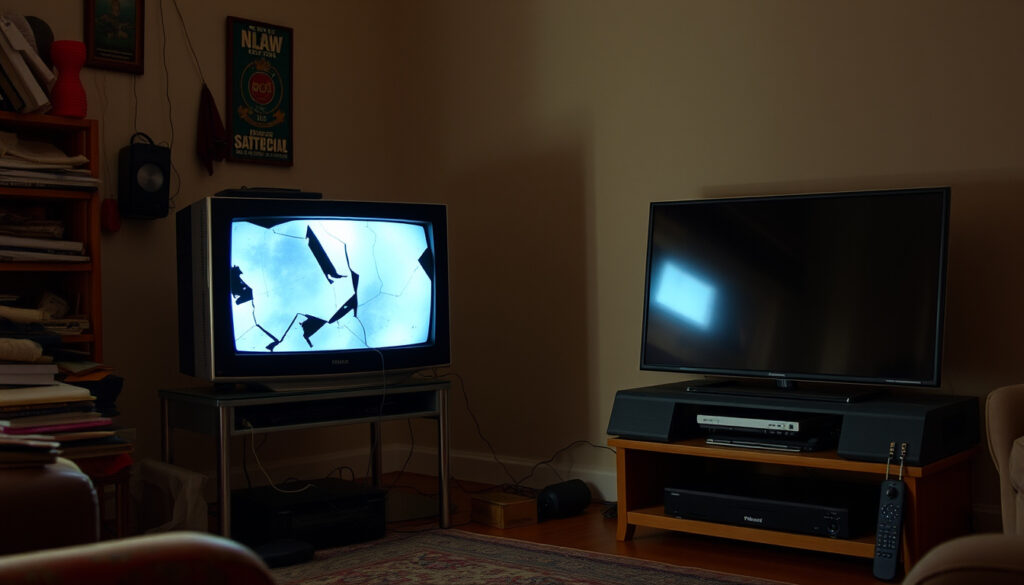
Few things are as frustrating as turning on your TV and seeing nothing but a blank screen — or worse, a cracked panel. Whether it’s a flickering image, no power, or the dreaded “No Signal” message, you’re now facing a decision: find a local TV repair service or start shopping for a replacement.
Average TV lifespan: 7–10 years · Typical repair cost: $200–$400 · Common issue: no signal: HDMI connection or input selection · DIY success rate: ~30% for simple resets · New TV average: $500–$1,500
Quick snapshot
- Power board repair is a common fix costing $200–$475 (Angi (home service platform))
- Average TV repair cost is $300 (HomeAdvisor (home services marketplace))
- Exact percentage of TVs repaired vs. replaced annually
- How regional labor rates affect average repair costs
- If TV is under 5 years old and repair cost < 50% of new, repair is usually better (Bammel TV Technology Services (Texas-based repair shop))
- Get a professional diagnosis, then compare quotes against replacement cost
- Consider DIY for simple resets before calling a technician
Five key facts, one pattern: repair costs cluster in the low hundreds, while screen replacements break the bank.
| Label | Value |
|---|---|
| Average TV Lifespan | 7–10 years |
| Typical Repair Cost | $200–$400 |
| Common Symptom: No Signal | Usually HDMI or input issue |
| DIY Fixes Work | Simple resets solve ~30% of problems |
Is it worth paying to repair a TV?
What factors affect repair cost?
- Labor: $65–$150 per hour (HomeAdvisor (home services marketplace))
- Parts: power board $30–$100, main board $50–$150 (TVPartsToday (online parts supplier))
- Screen replacement: $400–$4,200 (Angi (home service platform))
How does TV age influence the decision?
- TVs under 5 years: repair often makes sense if cost is below half the price of a similar new model (Bammel TV Technology Services (Texas-based repair shop))
- TVs over 7 years: replacement is usually cheaper than a major repair ($200–$500 repair vs. $500–$1,500 new)
Repairing an older TV may feel thrifty, but you’re investing in a chassis that already has years of capacitor wear. A new TV brings modern features (HDR, smart platform updates) and a fresh warranty.
Should You Repair or Replace Your Broken Flat Screen TV?
How to Know When Your TV is Worth Repairing Instead of Replacing
- Use the “50% rule”: if repair cost is less than half the price of a comparable new TV, repair (Bammel TV Technology Services (Texas-based repair shop))
- Consider non-monetary costs: installation, mounting changes, accessory upgrades (Bammel TV Technology Services (Texas-based repair shop))
What are the pros and cons of each option?
Three key trade-offs, one common thread: screen damage shifts the balance toward replacement.
Upsides
- Repair keeps your familiar TV with known picture quality
- Lower upfront cost than a new TV (<$400 vs. $500+)
- Eco-friendly – less e-waste
Downsides
- No warranty extension on aged components
- May still break again within a year
- Screen repairs are rarely cost-effective (TVPartsToday (online parts supplier))
A cheap repair on a 6-year-old TV might buy you a year, but a new TV typically includes a 2-year warranty and energy savings from more efficient LED drivers.
What is the most common TV problem?
What are the 5 most common TV problems and repairs?
- Power failure (dead set) – power board repair $200–$475 (Angi (home service platform))
- Backlight failure (dark screen with sound) – $100–$250
- No signal – usually HDMI/input source
- Cracked screen – rarely worth repairing
- Audio issues – speaker or main board
How to identify a power issue vs. screen damage
- Power issue: TV has no lights, no sound, no response. Check outlet and power cord first.
- Screen damage: visible cracks, lines, or discoloration even when backlight is on.
The implication: diagnosing the symptom correctly saves you from paying for a repair that won’t fix the root cause.
How do you fix the TV when it says no signal?
What to check first when you see No Signal
- Ensure the TV is on the correct input (HDMI1, HDMI2, etc.).
- Verify cables are firmly connected at both ends.
How to reset HDMI connections
- Unplug the HDMI cable from both TV and source device.
- Power cycle both devices: unplug for 60 seconds.
- Reconnect the HDMI cable and turn on devices. If still no signal, try a different HDMI port or cable.
If rebooting doesn’t work, the issue might be the source device or the TV’s HDMI port. A professional can test with known-good equipment.
Simple resets fix about 30% of no-signal issues. For the rest, a technician’s $65–$150 diagnostic fee is money well spent before you buy parts.
What is the average lifespan of a TV?
Does the lifespan vary by TV technology?
- LED/LCD: 7–10 years (typical)
- OLED: 5–7 years due to organic pixel wear
- QLED: 7–10 years (similar to LED)
When should you start planning for replacement?
- After year 6, set aside a replacement budget.
- If repair quotes exceed 50% of a new TV’s price, it’s time.
Repair vs. Replace: A side-by-side look
Three factors, one pattern: age and symptom determine the math.
| Factor | Repair | Replace |
|---|---|---|
| Cost | $200–$400 average (HomeAdvisor (home services marketplace)) | $500–$1,500 average |
| Best for | TVs under 5 years, minor issues (power board, backlight) | TVs over 7 years, screen cracks, multiple failures |
| Warranty | Usually 90-day on repair work | 1–2 year manufacturer warranty |
What this means: a $300 repair on a 4-year-old set with a power board issue is a sound investment, but the same repair on a 9-year-old TV is money you won’t get back.
Step-by-step: Troubleshoot before you call
- Power check: Ensure outlet works and TV has power light.
- Input check: Cycle through inputs using remote.
- Reset: Unplug for 60 seconds, then plug back in.
- Cable check: Swap HDMI cable and port.
- Factory reset: Use TV menu (if accessible) to restore defaults.
- Call a pro: If steps 1–5 fail, schedule a local technician (Best Buy (electronics retailer) offers in-home service for TVs 42″+)
What’s certain vs. what’s not
Confirmed facts
- Most common TV problem is power failure (Angi (home service platform))
- Average lifespan is 7–10 years
- Simple resets solve ~30% of problems
What’s unclear
- Exact percentage of TVs repaired vs. replaced annually
- How regional labor costs shift the average repair price
What the experts say
“Repair is usually superior when the cost of repair is less than half the cost of a similar new television.”
— Bammel TV Technology Services (Texas-based repair shop) (source)
“DIY TV repair can save on labor but may void the warranty, cause further damage, and expose the user to electrical hazards.”
— Angi (home service platform) (source)
For a household with a 6-year-old TV and a repair quote over $400, the decision is clear: replace it, or risk paying more for a repair that may not extend the TV’s life another two years. If you’re searching for “tv repair near me” and your set is under 5 years old with a minor fault, a repair still makes sense — just get three quotes and check the warranty.
Frequently asked questions
How can I tell if my TV is worth repairing?
Compare repair cost to 50% of a new TV’s price. If it’s less, repair is usually smart (Bammel TV Technology Services (Texas-based repair shop)). Also consider age: TVs over 7 years may be better replaced.
What brands most often need repair?
No single brand dominates repair statistics. However, older sets from any brand are more likely to need power board or backlight fixes.
Does a factory reset fix most TV issues?
No, but it can help with software glitches. Hardware issues (power, backlight, screen) require part replacement.
Is it cheaper to buy a new TV or repair?
For minor issues on a modern TV, repair is cheaper ($200–$400 vs. $500+). For cracked screens or TVs over 7 years, replacement wins.
Do TV repairs come with a warranty?
Most independent shops offer 60–90 days on parts and labor. Best Buy’s service includes a 90-day guarantee (Best Buy (electronics retailer)).
Can I repair my TV myself?
You can safely replace cables and perform resets. Opening the chassis risks electric shock and voided warranty. Boards inside can hold lethal voltages (Angi (home service platform)).
How long does a typical TV repair take?
In-home repairs often take 1–2 hours. If parts need ordering, expect 1–2 weeks.
Meer gerelateerde berichten
 Rock Orchestra by Candlelight: 2026 Dates, Reviews & Setlist
 What Time Is Eurovision 2025 – Schedule, Dates and Venue
 Cristiano Jr: Age, Height, Mother, and Football Stats
 Snag Tights Discount Code: Verified Coupons & Free Shipping
 Steven Seagal: Career, Life, and Martial Arts Legacy
 Man United vs Fulham 3-2: Sesko Late Winner, Highlights & Stats
 English to Bangla Translation – Best Free Tools 2025
 Brenda Vaccaro: Career, Relationships & Net Worth