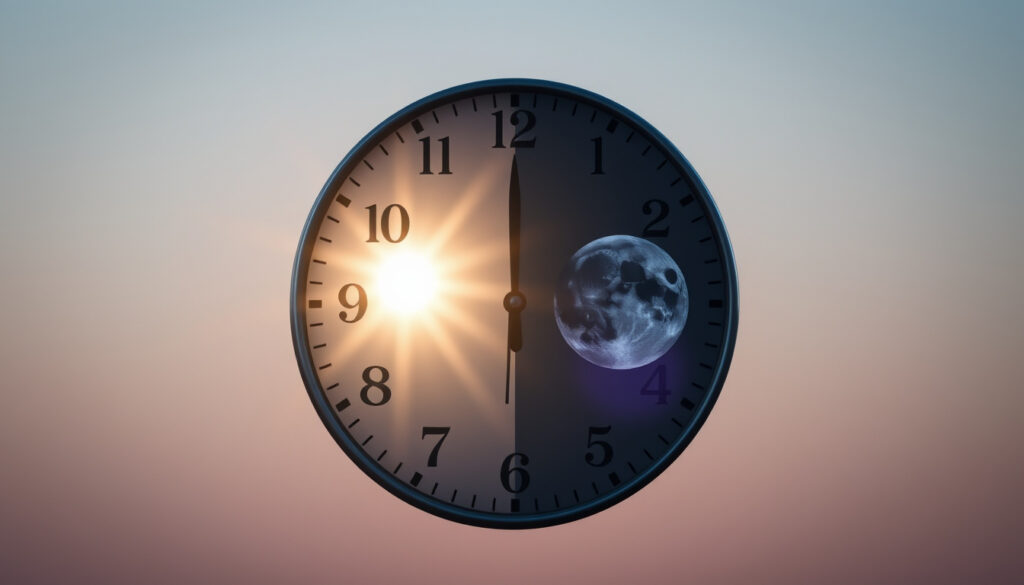
What Does AM and PM Stand For? Noon & Midnight Explained
If you’ve ever caught yourself second-guessing whether noon should be 12 AM or 12 PM, you’re in good company. There’s a logical wrinkle buried in how we mark the halfway point of the day—one that trips up plenty of people even after years of reading clocks. The confusion stems from Latin roots and a convention that never quite caught up with its own rules. This piece unpacks what those letters actually mean, why noon and midnight sit in an etymological grey zone, and what style guides say you should use instead.
AM Origin: Ante Meridiem (Latin for before midday) · PM Origin: Post Meridiem (Latin for after midday) · Clock System: 12-hour format
Quick snapshot
These cards summarise confirmed facts, open questions, historical context, and emerging standards.
- AM = ante meridiem, Latin for “before midday” (Royal Museums Greenwich)
- PM = post meridiem, Latin for “after midday” (Britannica)
- 12-hour clock divides the day into 2 periods (Wikipedia)
- Sundial invented circa 1500 B.C. in Ancient Egypt (Toolkit.law)
- Romans formalized ante/post meridiem terminology (Toolkit.law)
- Style guides increasingly recommend “noon” and “midnight” over numeric notation (Wikipedia)
- 24-hour clock adoption growing in professional contexts (Cuemath)
What do AM and PM actually stand for?
AM and PM are abbreviations derived from Latin. AM stands for ante meridiem, which translates to “before midday,” while PM comes from post meridiem, meaning “after midday.” This two-letter system emerged from the Latin-speaking ancient Romans, who formalized the division of the day into periods relative to the sun’s highest point (Britannica).
Latin origins
The word meridiem itself comes from two Latin roots: medius (middle) and dies (day). So when Romans talked about ante meridiem or post meridiem, they were literally referring to the time before or after the sun reached its zenith. The meridian—an imaginary north-south line connecting Earth’s geographic poles—gives us this conceptual anchor point for measuring the day (Britannica).
“The meridian—an imaginary north-south line on Earth’s surface—forms the basis for the 12-hour clock system’s division of day relative to the sun’s position.” — Britannica encyclopedia
Historical usage
Timekeeping with these Latin designations traces back to ancient Egypt and Babylon, where celestial observations shaped how people organized their days. Egyptians are credited with dividing the day into 24 hours and inventing the sundial around 1500 B.C. (Toolkit.law). The Romans later refined this into the linguistic framework we still use today.
The 12-hour clock system is based on the position of the Sun relative to the meridian—an imaginary north-south line connecting both geographic poles. This celestial framework, formalized by the Romans, remains the foundation of how we still mark time today.
The implication: these Latin terms anchored themselves in English timekeeping not through legislation but through scholarly convention spreading through trade and education.
Is noon 12 am or 12 pm?
Here’s where the system gets interesting—and a little contradictory. By strict Latin definition, noon is technically neither ante meridiem nor post meridiem. The sun has reached its highest point, so it’s not “before” nor “after” the meridian. Yet by widespread convention, 12 p.m. denotes noon (Wikipedia).
“Noon is therefore neither ‘ante’ (am) nor ‘post’ (pm) meridiem. Midnight is also neither am nor pm.” — Royal Museums Greenwich
Standard conventions
The logic goes like this: after 12:59 comes 1:00, which falls squarely in the afternoon. So treating 12 p.m. as noon keeps the numbers flowing logically into the post-midday cycle. Midnight, meanwhile, gets assigned 12 a.m. because it kicks off the “before midday” hours (Royal Museums Greenwich).
Style guide recommendations
Many style guides recommend against using 12 a.m. and 12 p.m. precisely because of this ambiguity. The preferred approach is to simply say “12 noon” or “noon” and “12 midnight” or “midnight” (Wikipedia). This sidesteps the Latin-logic problem entirely.
The reverse convention—12 a.m. for noon and 12 p.m. for midnight—has historically been used in some regions. This is precisely why professional contexts increasingly opt for “noon” and “midnight” instead of the numeric notation.
What this means: when precision matters, writing “noon” costs nothing and eliminates an ambiguity that has caused real scheduling errors.
Is midnight 12pm or 12am?
Midnight, like noon, sits outside the strict Latin definitions. By convention, 12 a.m. denotes midnight (Wikipedia). But if you stopped someone on the street, there’s a good chance they’d guess wrong—and that uncertainty has real-world consequences for scheduling, travel, and legal documents.
Common standards
In English-speaking countries, the standard practice is to treat 12 a.m. as midnight and 12 p.m. as noon. This convention is encoded in most digital clocks, scheduling software, and official time notation standards. The Royal Museums Greenwich explicitly confirms this on their timekeeping explainer (Royal Museums Greenwich).
Variations in usage
Interestingly, the reverse convention has been used historically. Some publications and regions have assigned 12 a.m. to noon and 12 p.m. to midnight, reasoning that midnight comes at the end of the day (p.m.) and noon at the beginning (a.m.). This split creates genuine confusion, which is why clarity-oriented style guides push for “noon” and “midnight” instead (Wikipedia).
The pattern: two legitimate conventions exist side by side, which guarantees confusion whenever “12:00” appears without context.
Is morning 12 AM or PM?
Morning runs from midnight to noon. Every moment from 12:00 a.m. through 11:59 a.m. falls under the AM designation. So if someone asks whether 12:30 in the morning is AM or PM, the answer is definitively AM—it’s half an hour past midnight, still firmly in the ante meridiem period (Cuemath).
Early morning times
The 12-hour clock cycles reset at noon and midnight. That means 1:00 AM through 12:59 AM covers the first hour of the day, while 1:00 PM through 12:59 PM covers the afternoon and evening. This pattern holds regardless of whether we’re talking about a quiet Tuesday morning or a busy Saturday night.
12:30 AM specifics
At 12:30 AM, you’re dealing with a time that’s 30 minutes past the midnight boundary. This falls squarely in the AM window—the “before midday” portion of the day. Whether it’s a red-eye flight departure or a late-night work call, the designation remains consistent.
The implication: anyone scheduling early-morning activities should always use AM notation and verify their calendar software interprets “12:00” correctly.
What does “o’clock” actually mean?
The phrase “o’clock” comes from a older English construction meaning “of the clock.” Before watches and smartphones gave us precise readings, saying “six of the clock” meant six hours as measured by a specific timepiece. The “o” essentially absorbed the preposition, leaving us with the shorthand we use today.
Etymology
The full phrase would have been “of the clock” in Middle English—hence “seven o’clock” meaning “seven of the clock.” This distinction mattered when different towns kept slightly different local times based on their own sun observations. Referring to “the clock” meant referring to a specific, agreed-upon instrument.
Related time terms
Other time-related expressions carry similar historical weight. “High noon” references when the sun reaches its apex. “Midnight” literally means “middle of the night.” These terms evolved alongside the 12-hour clock system as people sought clearer ways to communicate when something happened.
The catch: even familiar time words carry etymological baggage that shapes how we interpret them today.
| Label | Value |
|---|---|
| AM Full Form | Ante Meridiem |
| PM Full Form | Post Meridiem |
| Noon Time | 12:00 p.m. |
| Midnight Time | 12:00 a.m. |
| 12-Hour Clock | Common in English-speaking countries |
Related reading: train times · timeline
While AM and PM clarify the 12-hour clock around noon and midnight, PM also signifies politics and messaging in PM meanings across contexts.
Frequently asked questions
What is the difference between AM and PM?
AM (ante meridiem) covers midnight to noon, while PM (post meridiem) covers noon to midnight. The 12-hour clock divides the 24-hour day into two 12-hour periods, with AM representing the “before midday” hours and PM representing the “after midday” hours.
Why is there confusion about 12 AM and 12 PM?
Both noon and midnight technically fall outside the Latin definitions of ante meridiem and post meridiem. By convention, 12 p.m. denotes noon and 12 a.m. denotes midnight, but this creates logical tension since neither moment is truly “before” or “after” the meridian. Many style guides recommend using “noon” and “midnight” instead.
Does 12:30 AM count as morning?
Yes. Any time from 12:00 a.m. through 11:59 a.m. falls in the morning and uses AM designation. This includes the early hours typically called “early morning” or “late night” depending on context.
Is 12 PM lunchtime?
Yes, 12 p.m. is the conventional designation for noon, which typically coincides with lunchtime. However, some people still refer to the lunch hour as 1 p.m., so “lunchtime” can be a somewhat flexible term depending on cultural context.
What time system uses AM and PM?
The 12-hour clock system uses AM and PM. It’s common in English-speaking nations and former British colonies. The alternative is the 24-hour clock system, which eliminates ambiguity by running from 00:00 (midnight) to 23:59 (one minute before the next midnight).
How do military clocks handle AM/PM?
Military time and many professional contexts use the 24-hour clock system, which doesn’t need AM or PM designations. Hours run from 00:00 to 23:59, with 00:00 representing midnight and 12:00 representing noon.
Are there alternatives to AM and PM?
Yes. The 24-hour clock eliminates AM/PM entirely by using a continuous count from 0 to 24. Many countries use this system as standard, while others use it in specific professional contexts like aviation, healthcare, and military operations.
Related reading
- Royal Museums Greenwich (Historic timekeeping authority)
- Britannica (Encyclopedia with Latin etymology)
- Wikipedia (12-hour and 24-hour clock systems)
- Cuemath (Educational math platform)
Meer gerelateerde berichten
 Properties to Rent Near Me – Top Platforms, Prices and Tips
 Community Fibre Contact Number: Phone, Live Chat & Hours
 Mary Earps: Relationship, Salary, and Why She Left England Duty
 How to Make Mac and Cheese – Creamy Stovetop Recipe Guide
 Elvis Costello: Biography, Illness, Hits & Facts
 Brenda Vaccaro: Career, Relationships & Net Worth
 British Airways Multi City: How to Book Flights & Holidays
 Tom Amandes: Actor Biography, Best TV Roles & Key Facts