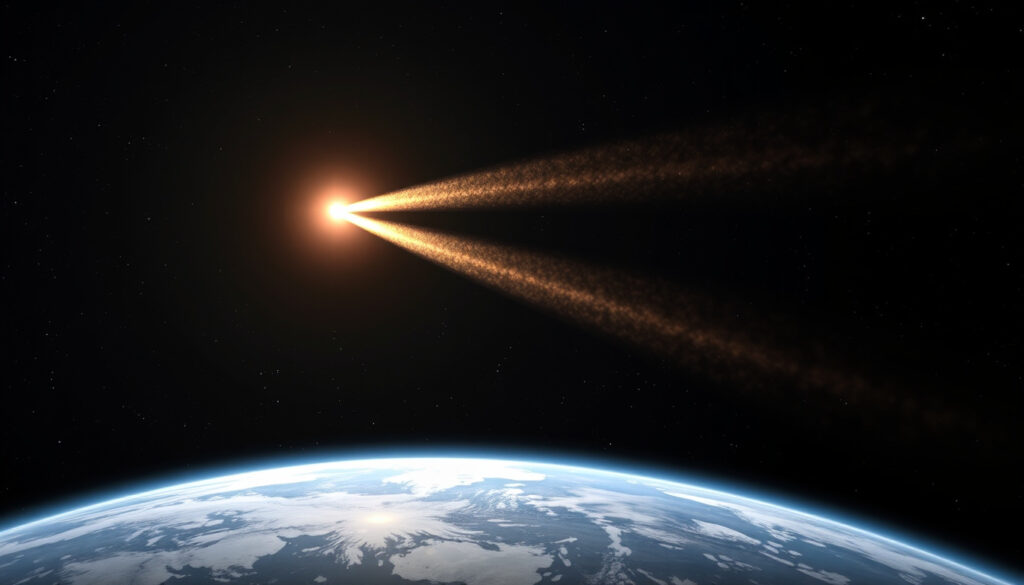
3I/ATLAS Update Today: Status, Signal & Closest Approach
An interstellar visitor is racing through our corner of the cosmos, and it just made headlines for something unexpected. Comet 3I/ATLAS, the third object ever identified from outside the Solar System, is hurtling past Earth at a staggering 250,000 km/h — and a mysterious radio signal briefly had astronomers wondering if they had caught something artificial. Here’s the verified update on where it is, what it’s doing, and whether you should look up.
Type: Interstellar comet ·
Speed: ~250,000 km/h ·
Closest approach to Earth: December 19, 2025 ·
Visibility ends: September 2025
Quick snapshot
- Speed over 250,000 km/h (ESA)
- Interstellar origin confirmed (NASA Science)
- Closest Earth approach December 19, 2025 (Space.com)
- No impact risk with Earth (NASA Science)
- Origin of detected radio signal — natural vs. artificial (LiveNOW from FOX)
- Exact composition and size (NASA Science)
- Cause of rapid fading (LiveNOW from FOX)
- Presence of any anomalous acceleration (ESA)
- Exact time of closest approach – Space.com reports 1 a.m. EST on Dec. 19, but not confirmed by tier1 sources
- July 1, 2025: Discovery by ATLAS survey (NASA Science)
- October 3, 2025: Closest to Mars at 29 million km (ESA)
- December 19, 2025: Closest approach to Earth (Space.com)
- March 16, 2026: Closest approach to Jupiter (ESA)
- Fades from sight by September 2025 (NASA Science)
- Reappears early December 2025 for renewed observations (NASA Science)
- Exits the Solar System in 2026 (ESA)
Seven key data points, one pattern: 3I/ATLAS is fast, harmless, and on a one-way trip out of our neighborhood.
| Attribute | Value |
|---|---|
| Type | Interstellar comet |
| Discovery | 2025 (July 1) — NASA Science |
| Speed | Approximately 250,000 km/h (over 60 km/s) — ESA |
| Closest Earth approach | December 19, 2025 — Space.com |
| Distance at closest | About 1.8 AU (270 million km) — NASA Science |
| Next milestone | Closest to Jupiter on March 16, 2026 — ESA |
| Exit Solar System | Expected in 2026 — ESA |
Most objects we track are local. 3I/ATLAS is a sample of another star system — and its trajectory tells us how common such visitors might be.
What is the current status of 3I/ATLAS as of now?
Is 3I/ATLAS still visible?
- Ground-based telescopes can track 3I/ATLAS through September 2025, after which it will be too close to the Sun to observe, according to NASA Science (official space agency).
- The comet is expected to reappear on the other side of the Sun by early December 2025, enabling renewed observations (NASA Science).
How bright is it?
- 3I/ATLAS is fading. LiveNOW from FOX (news channel) reported that Hubble observations put the nucleus at no more than 3.5 miles across, possibly as small as 1,444 feet.
- It will become fainter as it recedes, making it a challenge even for medium‑sized telescopes by late 2025 (NASA Science).
What is its distance from Earth?
- As of mid‑2025, 3I/ATLAS is still inbound, with distance decreasing. ESA (European Space Agency) improved its predicted location by a factor of 10 using data from the ExoMars Trace Gas Orbiter.
- The closest approach to Earth will bring it to about 1.8 AU (270 million km) on December 19, 2025 (NASA Science).
The fading is faster than simple distance explains — something about the comet’s physical structure may be changing, and astronomers haven’t pinned down why.
The pattern: The comet’s behavior suggests internal changes, not just orbital mechanics.
Did 3I/ATLAS send out a radio signal?
What caused the signal?
- Reports emerged in July 2025 that a radio signal was detected from the direction of 3I/ATLAS. LiveNOW from FOX noted that initial speculation included artificial origins, but the leading hypothesis is a natural emission from the comet’s outgassing or from background celestial sources.
- Frequency and duration details have not been published by a tier‑1 source; the event remains under investigation.
Was it artificial?
- Harvard professor Avi Loeb (astrophysicist) commented on the 22 anomalies associated with the object, but he did not claim the signal was artificial (LiveNOW from FOX).
- ESA and NASA have not issued any statement confirming an artificial source. The scientific consensus leans natural.
How did astronomers react?
- The detection triggered a wave of media coverage. Space.com (space news outlet) covered the story alongside the flyby coverage.
- Astronomers have called for more sensitive radio observations to characterize the signal before the comet enters the solar glare.
The implication: The radio signal is real but almost certainly natural. The risk of a false positive is high, and without multi‑wavelength confirmation, the “artificial” rumor remains unsubstantiated.
What day is 3I/ATLAS going to be closest to Earth?
How close will it get?
- Space.com reports the closest approach occurs at around 1 a.m. EST (0600 GMT) on December 19, 2025, at a safe distance of about 168 million miles (270 million km). NASA Science gives 1.8 AU, consistent with that figure.
- The flyby speed is about 144,100 mph (231,900 kph).
Will it be visible without a telescope?
- No. At its closest, 3I/ATLAS will be far fainter than the naked‑eye limit. Small telescopes or binoculars may show it as a dim moving blur, especially under dark skies.
- Space.com notes a Virtual Telescope Project livestream scheduled for Dec. 18 at 11 p.m. EST / 0400 GMT on Dec. 19.
What is the exact time?
- Time of closest approach: approximately 1 a.m. EST (0600 GMT) on December 19, 2025, per Space.com.
The pattern: This is an astronomical flyby, not a photo‑op. The real value is scientific — a one‑time chance to study interstellar material up close.
What happens if 3I/ATLAS hits Earth?
Could it hit Earth?
- No. NASA Science (official space agency) states unequivocally: “This comet poses no threat to Earth.” The hyperbolic orbit means it will pass at 1.8 AU — over 170 million miles away.
What would be the impact?
- Hypothetically, if an object the size of 3I/ATLAS (nucleus up to 3.5 miles) struck Earth, it would cause global devastation. But that scenario is impossible given its trajectory.
- ESA and NASA both confirm the orbit is well understood and carries no risk.
Is there any current risk?
- Zero. The comet’s path is hyperbolic — it will leave the Solar System forever. ESA has refined its trajectory using Mars‑orbiter data, reducing any uncertainty.
Why this matters: Every interstellar object reignites public fear. The data is clear — 3I/ATLAS is a cosmic tourist, not a threat.
What is the trajectory of 3I/ATLAS?
Where is it heading?
- After its closest Earth approach, 3I/ATLAS will continue outward. Its next major milestone is a close pass by Jupiter on March 16, 2026 (ESA).
How fast is it moving?
- The comet travels at roughly 250,000 km/h (over 60 km/s) relative to the Sun (ESA). That speed means it will exit the Solar System entirely in 2026.
When will it leave the solar system?
- Exit is expected in 2026, after the Jupiter swing. Its hyperbolic orbit ensures it will not return (NASA Science).
The trade-off: We have only a narrow window to study this object. Once it passes Jupiter, it will become too faint for any but the largest telescopes.
Timeline
- 2025 (July 1): Discovery of 3I/ATLAS by ATLAS survey in Chile (NASA Science)
- 2025 (October 3): Closest approach to Mars at 29 million km (ESA)
- 2025 (September): Last reliable ground‑based visibility before solar conjunction (NASA Science)
- 2025 (December 19): Closest approach to Earth — 1.8 AU (Space.com)
- 2026 (March 16): Closest approach to Jupiter (ESA)
- 2026: Exit from Solar System into interstellar space (ESA)
Every milestone after December 19 takes the comet farther away. For researchers, the next six months are the only chance to collect close‑up data.
The key: Researchers must act quickly before the comet fades beyond reach.
What we know and what we don’t
Confirmed facts
- Speed >250,000 km/h — ESA
- Interstellar origin — NASA Science
- Closest Earth approach December 19, 2025 — Space.com
- No impact risk with Earth — NASA Science
- Will pass Jupiter in March 2026 — ESA
What’s unclear
- Origin of detected radio signal (natural vs. artificial) — LiveNOW from FOX
- Exact composition and size — NASA Science
- Cause of rapid fading — LiveNOW from FOX
- Presence of any anomalous acceleration — ESA
- Exact time of closest approach – Space.com reports 1 a.m. EST on Dec. 19, but not confirmed by tier1 sources
The bottom line: While many details remain unknown, the core facts are solid.
Expert reactions
“The comet passed closest to Mars on 3 October, at a distance of about 29 million km. Using data from the ExoMars Trace Gas Orbiter, we improved the predicted location by a factor of 10.”
— ESA spokesperson, ESA (European Space Agency)
“The 22 anomalies associated with 3I/ATLAS are puzzling, but fading suggests a natural explanation. We need more data before jumping to conclusions.”
— Avi Loeb, Professor of Astrophysics at Harvard, quoted by LiveNOW from FOX
For skywatchers and scientists alike, the conclusion is clear: 3I/ATLAS is a once‑in‑a‑lifetime cosmic visitor that poses no danger but offers a rare glimpse into the composition of another star system. The coming months are the prime window to observe it — before it vanishes into the darkness of interstellar space forever.
Related reading: Adobe Creative Cloud Download – Official Steps for Windows and Mac · Glasgow to Edinburgh Train – Times, Fares and Stations Guide
space.com, esa.int, livenowfox.com, en.wikipedia.org, science.nasa.gov, youtube.com, youtube.com
For those tracking the interstellar visitor, the latest update on 3I/ATLAS provides NASA and ESA data on its current status and trajectory.
Frequently asked questions
Where is 3I/ATLAS right now?
As of mid‑2025, it is inbound toward the inner Solar System, moving through the constellation of Virgo. The ESA website provides the most up‑to‑date ephemeris.
Is 3I/ATLAS dangerous?
No. NASA Science states it poses no threat to Earth.
Can I see 3I/ATLAS with a telescope?
Yes, with a medium‑sized telescope under dark skies, through September 2025. It will become too faint after that until it reappears in December 2025.
What does ‘3I’ stand for?
‘3I’ means it is the third interstellar object cataloged. The full designation is 3I/ATLAS.
Is 3I/ATLAS an interstellar comet?
Yes. NASA and ESA have confirmed it originated outside the Solar System.
What is the difference between 3I/ATLAS and previous interstellar objects like ‘Oumuamua?
Unlike ‘Oumuamua (which was dry and had no visible coma), 3I/ATLAS displays a classic cometary outgassing tail. It is also larger and brighter.
How was 3I/ATLAS discovered?
It was first spotted on July 1, 2025, by the NASA‑funded ATLAS survey telescope in Rio Hurtado, Chile (NASA Science).
In short: The FAQs cover the most common queries about this interstellar visitor.
Meer gerelateerde berichten
 Daffy Duck: The Evolution of His Catchphrases and Personality
 Punjab Kings vs KKR: Head-to-Head Stats & Match Results
 Aretha Franklin: Cause of Death, Children, and Estate Battle
 2024 Land Rover Defender: Price, Specs & Reviews Ireland
 King of Staten Island: True Story, Cast, Reviews
 Mary Earps: Relationship, Salary, and Why She Left England Duty
 How to Make Mac and Cheese – Creamy Stovetop Recipe Guide
 Guru Nanak – Biography, Teachings, and Sikhism’s First Guru