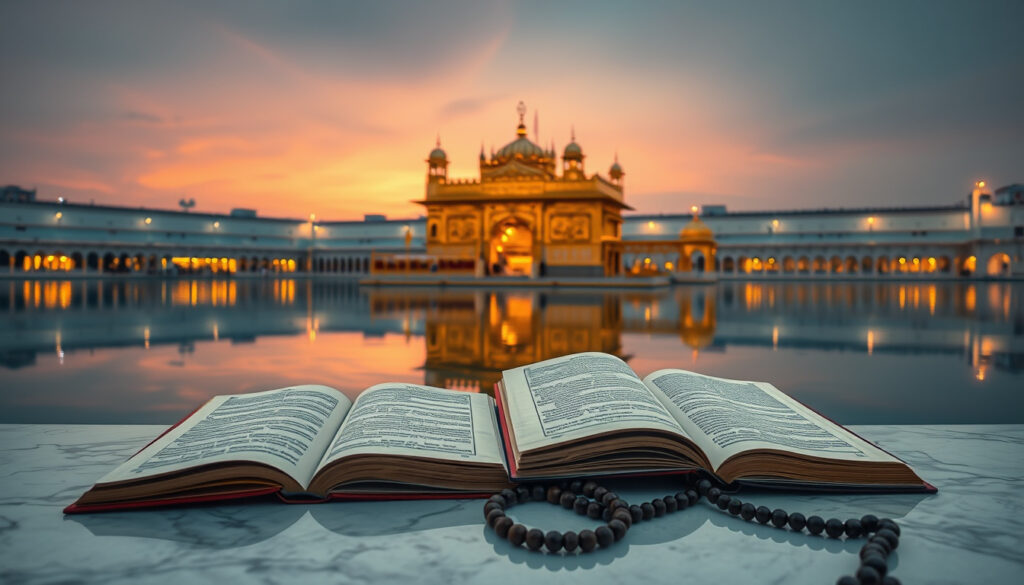
Guru Nanak – Biography, Teachings, and Sikhism’s First Guru
Few religious founders have left a mark as enduring as Guru Nanak, the first Sikh Guru. Born in 1469 in what is now Pakistan, he openly challenged the religious orthodoxy of his time with a message of radical equality. His famous words, “There is no Hindu, there is no Muslim,” still resonate today.
Born: 1469 ·
Died: 1539 ·
Founder of: Sikhism ·
First Sikh Guru: Yes ·
Place of Birth: Talwandi (now Nankana Sahib, Pakistan) ·
Number of Sikh Gurus: 10
Quick snapshot
- Birth year 1469 (Wikipedia – Sikh history reference)
- Death year 1539 (Wikipedia – Sikh history reference)
- Founder of Sikhism (Encyclopaedia Britannica – religion reference)
- First of ten Sikh Gurus (Golden Temple Amritsar – Sikh history)
- Exact routes of all his travels (Encyclopaedia Britannica – religion reference)
- Some early life details (e.g., pre-revelation activities) (SikhNet – Sikh community source)
- Interpretation of his stance on modern LGBTQ issues (Encyclopaedia Britannica – religion reference)
- 1499: Divine revelation at the river Bein begins his preaching (Golden Temple Amritsar – Sikh history)
- Modern Sikh groups continue debating LGBTQ inclusion (Encyclopaedia Britannica – religion reference)
- Gender equality remains a central, though contested, Sikh principle (Encyclopaedia Britannica – religion reference)
Eight core facts from authoritative sources give a quick reference for Guru Nanak’s life.
| Label | Value |
|---|---|
| Full Name | Guru Nanak Dev Ji |
| Born | 1469 |
| Died | 1539 |
| Place of Birth | Talwandi (now Nankana Sahib, Pakistan) |
| Spouse | Mata Sulakhni |
| Children | Sri Chand, Lakhmi Das |
| Founder of | Sikhism |
| First Sikh Guru | Yes |
What was Guru Nanak famous for?
What are Guru Nanak’s key teachings?
- One God (Ik Onkar): God is formless, eternal, and omnipresent (Golden Temple Amritsar – Sikh theology).
- Equality of all humans: No caste, no gender hierarchy (Encyclopaedia Britannica – religion reference).
- Three pillars: Nam Japo (meditate on God’s name), Kirat Karo (honest work), Vand Chhako (share with others) (Golden Temple Amritsar – Sikh history).
Guru Nanak’s message was radical for its time: he rejected idolatry, ritualism, and the caste system, arguing that devotion to one God and service to others mattered more than birth or class. His teachings, compiled in the Guru Granth Sahib, remain the spiritual bedrock of Sikhism.
A 15th-century South Asia deeply divided by caste and religion received a message that all humans share the same divine spark. That idea didn’t just survive – it laid the foundation for one of the world’s largest religions.
How did Guru Nanak found Sikhism?
- After his divine revelation at the River Bein in 1499, Guru Nanak began traveling – the udasis – to spread his teachings across India, the Middle East, and Southeast Asia (SikhNet – community source).
- He settled in Kartarpur around 1526, establishing a community (sangat) that later became the Sikh congregation (Encyclopaedia Britannica – religion reference).
- Before his death, he appointed Guru Angad as his successor, institutionalizing the lineage of Sikh Gurus (Wikipedia – Sikh history reference).
In contrast to founders who built temples and empires, Guru Nanak built a community around shared egalitarian values – a structure that would outlive him by centuries.
The pattern: his “institution” was not a building but a network of people committed to honest living, prayer, and charity. That network became Sikhism.
Was Guru Nanak a Hindu?
Why did Guru Nanak reject Hinduism?
- Born into a Hindu family (Khatri caste), Guru Nanak critiqued the caste system and idol worship as barriers to true spirituality (Encyclopaedia Britannica – religion reference).
- He sought a middle path between the ritualism of Hinduism and the exclusivity of Islam, famously stating “There is no Hindu, there is no Muslim” (Wikipedia – Sikh history reference).
This wasn’t a personal rebellion; it was a theological statement that God is beyond labels. For Guru Nanak, one could be a disciple of God (a Sikh) without claiming any one religious identity.
What was Guru Nanak’s religious background?
- He grew up in a Hindu family in Talwandi, but was exposed to Islam through the local Muslim population (Encyclopaedia Britannica – religion reference).
- He worked as a storekeeper before his revelation, a job that put him in contact with both Hindus and Muslims (SikhNet – community source).
The implication: Guru Nanak didn’t reject his heritage wholesale; he rejected the sectarianism that divided people who shared a common humanity.
Which God did Guru Nanak worship?
What is the concept of Ik Onkar?
- “Ik Onkar” means “One God” – a single, formless, eternal reality that is the source of all existence (Golden Temple Amritsar – Sikh theology).
- This God is described as nirbhau (without fear) and nirvair (without enmity) in the opening of the Guru Granth Sahib (Wikipedia – Sikh theology).
By stressing the oneness and formlessness of God, Guru Nanak rejected polytheistic worship and the idea of divine intermediaries. The trade-off: a monotheism that could coexist with other faiths but left no room for idolatry.
How does Sikhism’s view of God differ from Hinduism?
- Hinduism generally accepts a multiplicity of gods and manifestations; Sikhism is uncompromisingly monotheistic (Encyclopaedia Britannica – religion reference).
- Sikhism rejects the avatar concept (God taking human form); for Guru Nanak, God is beyond birth and death (Wikipedia – Sikh history reference).
The catch: while Sikhism and Hinduism share cultural roots, their understanding of the divine is fundamentally different – one is a non-dual, personal God, the other a vast pantheon.
Does Sikhism accept LGBTQ?
Is Sikhism against LGBTQ?
- The Guru Granth Sahib does not mention LGBTQ issues directly, so the tradition has no explicit scripture on it (Encyclopaedia Britannica – religion reference).
- Many modern Sikh groups take a conservative view, viewing marriage as between a man and woman for procreation (SikhNet – community source).
- However, some progressive Sikh organizations argue that Guru Nanak’s core message of equality includes LGBTQ persons (Encyclopaedia Britannica – religion reference).
This isn’t a settled debate. The absence of explicit condemnation in scripture leaves room for interpretation, but traditional practice leans conservative.
Are condoms allowed in Sikhism?
- Sikhism does not explicitly forbid contraception; the focus is on responsible family life (Encyclopaedia Britannica – religion reference).
- Condoms for health reasons (e.g., preventing disease) are generally accepted (SikhNet – community source).
The pattern: Sikh ethics emphasize intentionality and responsibility, not blanket bans.
Is kissing allowed in Sikhi?
- No scriptural prohibition exists; kissing is a personal matter (Encyclopaedia Britannica – religion reference).
- Cultural norms may frown upon public displays of affection, but that’s social, not religious (SikhNet – community source).
How do Sikhs treat their wives?
What is the role of women in Sikhism?
- Guru Nanak preached against sati (widow-burning) and purdah (veiling), advocating for women’s full participation in religious life (Encyclopaedia Britannica – religion reference).
- Women can lead prayers, perform ceremonies, and read the Guru Granth Sahib in gurdwaras (Golden Temple Amritsar – Sikh history).
The radical idea: a 15th-century religious leader telling his followers to treat women as equals. That made Guru Nanak an outlier in his time.
Are women equal in Sikhism?
- In theory, yes: Sikhism teaches spiritual equality between genders (Encyclopaedia Britannica – religion reference).
- In practice, cultural patriarchy often overrides scripture, with women facing discrimination in some communities (SikhNet – community source).
The trade-off: a progressive religious foundation meets conservative cultural norms. The gap between principle and practice remains a key challenge for modern Sikhism.
What country is 80% Hindu?
Which country has the largest Hindu population?
- India has the world’s largest Hindu population, with approximately 80% of its population identifying as Hindu according to Indian census data (Wikipedia – Hinduism in India).
This demographic context matters: Sikhism emerged from the Hindu-majority Punjab region, sharing cultural roots while establishing a distinct religious identity.
How does Sikhism relate to Hinduism demographically?
- Sikhs are a small minority in India (about 1.7% of the population) but concentrated in Punjab (Wikipedia – Sikhism in India).
- The two religions share historical and linguistic connections but are theologically distinct (Encyclopaedia Britannica – religion reference).
What this means: India’s religious landscape is dominated by Hinduism, but the Sikh tradition – founded by Guru Nanak – stands as a separate, monotheistic faith with its own scripture and practices.
Three key differences highlight how Guru Nanak’s teachings broke from the Hindu tradition he was born into.
| Aspect | Sikhism (Guru Nanak’s vision) | Hinduism (common 15th-century practice) |
|---|---|---|
| Concept of God | One formless God (Ik Onkar) | Multiple gods and goddesses; divine incarnations |
| Caste system | Rejected; all humans equal | Accepted as social hierarchy |
| Idol worship | Forbidden; God is beyond form | Widespread idol veneration |
Timeline of Guru Nanak’s life
- 1469: Born in Talwandi (Wikipedia – Sikh history reference)
- 1499: Divine revelation at the river Bein, begins preaching (Golden Temple Amritsar – Sikh history)
- 1500–1524: Travels (udasis) across South Asia and Middle East (SikhNet – community source)
- 1526: Settles in Kartarpur, establishes community (Encyclopaedia Britannica – religion reference)
- 1539: Dies, appoints Guru Angad as successor (Wikipedia – Sikh history reference)
Confirmed facts vs. unclear points
Confirmed facts
- Birth year 1469 (Wikipedia – Sikh history reference)
- Death year 1539 (Wikipedia – Sikh history reference)
- Founder of Sikhism (Encyclopaedia Britannica – religion reference)
- First of ten Gurus (Golden Temple Amritsar – Sikh history)
- Major teachings from Guru Granth Sahib (Encyclopaedia Britannica – religion reference)
What’s unclear
- Exact routes of all udasis (Encyclopaedia Britannica – religion reference)
- Some early life details (SikhNet – community source)
- Interpretation of his stance on LGBTQ (Encyclopaedia Britannica – religion reference)
- Disputed death year (1538 vs. 1539) (Encyclopaedia Britannica – religion reference)
Quotes from Guru Nanak
“There is no Hindu, there is no Muslim.”
– Guru Nanak (attributed)
“Ik Onkar, Sat Nam, Karta Purakh, Nirbhau, Nirvair, Akal Murat, Ajuni, Saibhang, Gur Prasad.”
– Opening of Japji Sahib
Wikipedia – Sikh scripture reference
For Sikhs worldwide, the challenge remains: how do you honor a Guru who demolished hierarchies when the world still builds walls around gender, caste, and sexuality? The inheritance is both radical and unfinished. For anyone exploring Sikhism, the path is clear: study Guru Nanak’s words directly, or let tradition speak on your behalf – but one is truer to his message than the other.
Related reading: Pakistani Shami Kebab Near Me · Glasgow to Edinburgh Train
For those interested in the annual celebrations, details on Guru Nanak Dev Jis 2025 birthday provide a comprehensive overview of the date and traditions.
Frequently asked questions
What is Guru Nanak Jayanti?
It’s the birthday of Guru Nanak, celebrated by Sikhs as the most important gurpurab (festival). The date follows the lunar calendar.
How is Guru Nanak’s birthday celebrated?
With akhand paath (continuous reading of Guru Granth Sahib), processions (nagar kirtan), and free community meals (langar) at gurdwaras.
What are the three pillars of Sikhism?
Naam Japo (meditating on God’s name), Kirat Karo (honest work), Vand Chhako (sharing with others) – all taught by Guru Nanak.
Who are the ten Sikh Gurus?
Guru Nanak, Guru Angad, Guru Amar Das, Guru Ram Das, Guru Arjan, Guru Har Gobind, Guru Har Rai, Guru Har Krishan, Guru Tegh Bahadur, and Guru Gobind Singh.
What is the Guru Granth Sahib?
The central religious scripture of Sikhism, containing hymns and teachings from Guru Nanak and other Sikh Gurus, as well as saints from Hindu and Muslim traditions.
Why is Guru Nanak called ‘Guru’?
‘Guru’ in Sanskrit means ‘teacher’ or ‘enlightener’. For Sikhs, Guru Nanak is the spiritual teacher who leads from darkness to light.
What is the main message of Guru Nanak’s teachings?
To live a life of truth, equality, devotion to one God, and service to humanity – all while rejecting caste, idolatry, and religious hypocrisy.
Meer gerelateerde berichten
 Robin Williams Cause of Death and Lewy Body Dementia Misdiagnosis
 Tim Henman: Net Worth, Career, Friendships & Life After Tennis
 John Davidson Tourette: Activist, Documentary, and BAFTA Incident
 The Fault in Our Star : Banned Book, Cancer, Sad Ending
 Freya Skye Age, Real Name, Songs & ZOMBIES Role
 Xbox Series S Controller – Complete Specs, Compatibility and Setup
 World Darts Championship 2025 Schedule – Dates, Draw and TV Guide
 Carla Connor: A Guide to Her Marriages, Tragedies, and Love Life