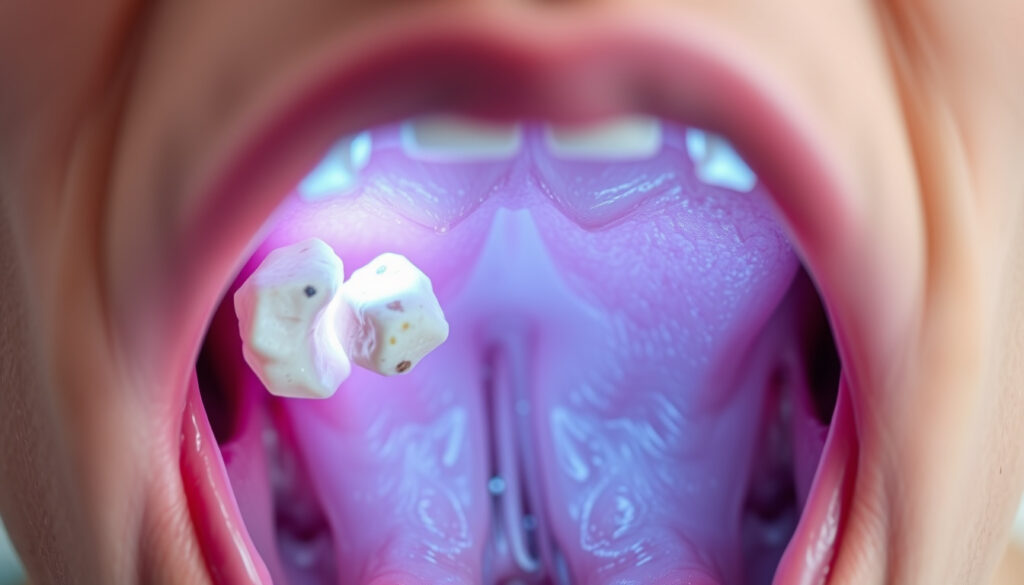
How to Remove Tonsil Stones: Causes, Remedies, Prevention
If you’ve ever felt that annoying tickle in your throat and wondered what those little white lumps are, you’re not alone — tonsil stones are a common nuisance that many people deal with quietly, often without knowing exactly what they are or how to handle them. This guide lays out safe, evidence-backed methods to remove them at home, explains why they form, and helps you stop the bad breath they can cause.
Prevalence: Affects up to 10% of adults (Cleveland Clinic) ·
Common age group: Most frequent in young adults (Mayo Clinic) ·
Cause of bad breath: Sulfur compounds produced by bacteria in stones are a primary source of halitosis (Scripps Health) ·
Self-resolution rate: Many stones dislodge on their own without intervention (Medical News Today)
Quick snapshot
- Small, whitish-yellow lumps in tonsil crypts (Cleveland Clinic)
- Made of hardened bacteria, dead cells, and food debris (Cleveland Clinic)
- Usually harmless but can cause bad breath (Cleveland Clinic)
- Persistent bad breath (halitosis) (Scripps Health)
- Sore throat or feeling of something stuck (Mayo Clinic)
- White or yellow spots on tonsils (Mayo Clinic)
- Gentle gargling with warm salt water (ENT Care Centers)
- Using a moistened cotton swab to nudge stones out (ENT Care Centers)
- Water flosser on lowest setting (Delta Dental SD)
- If stones recur frequently or cause pain (Healthdirect)
- If swallowing or breathing becomes difficult (Healthdirect)
- If you suspect an infection or abscess (Healthdirect)
Five key facts that set the stage for everything that follows:
| Fact | Detail |
|---|---|
| Definition | Tonsil stones (tonsilloliths) are calcified debris trapped in the tonsil crypts |
| Typical size | Range from tiny specks to pea-sized (rarely larger) |
| Primary cause | Bacterial accumulation and poor oral hygiene |
| Smell cause | Sulfur compounds produced by anaerobic bacteria |
| Self-care success rate | Most stones dislodge with home methods within days |
- Salt water gargle: Mix 1 teaspoon salt in 8 ounces warm water, gargle for 15–30 seconds (ENT Care Centers). Repeat several times a day.
- Cotton swab nudge: Moisten a clean cotton swab with water or salt water, gently press around the stone to dislodge it (ENT Care Centers).
- Water flosser: Use on the lowest setting, aim water stream at the stone for about 20 seconds (Delta Dental SD). Avoid high pressure.
- Cough or swallow: A vigorous cough or forceful swallow can dislodge loose stones, especially after gargling (RVC Dental Suite).
What dissolves tonsil stones quickly?
When a stone is already formed, the fastest approach is usually gentle physical disruption combined with a dissolving agent. Here are the three most reliable techniques, backed by otolaryngology guidelines.
Salt water gargle effectiveness
A salt water gargle is the first line of defense. Mix 1 teaspoon of salt in 8 ounces of warm water and gargle for 15–30 seconds. The warmth helps loosen debris, and the salt creates an osmotic effect that may shrink the stone slightly. ENT Care Centers (otolaryngology practice) recommends this as a gentle daily method. Repeat several times a day until the stone dislodges.
Apple cider vinegar gargle
Apple cider vinegar’s acidity is thought to break down the calcified material. Dilute one part vinegar with two parts warm water and gargle for a few seconds. Healthline (health information publisher) notes this may help, though evidence is mostly anecdotal. Do not swallow the mixture, and avoid it if you have acid reflux or sensitive gums.
Water flosser (irrigator) use
A water flosser on its lowest setting can flush stones out of the crypts. Aim the stream directly at the stone for about 20 seconds. Delta Dental of South Dakota (dental health authority) recommends this as a non-invasive option. Use only the lowest pressure to avoid tissue injury.
Salt water is the safest daily tool; apple cider vinegar and water flossers are useful additions but come with caveats. For someone with sensitive tonsils, the water flosser may actually push stones deeper if used at too high a pressure.
The implication: Start with the simplest method—salt water—before moving to more aggressive tools. If the stone is deeply lodged, skip DIY methods and consult an ENT.
Can I remove a tonsil stone myself?
Yes, self-removal is possible for visible, surface-level stones, but it requires caution. Here’s how to do it safely and when to stop.
Safe self-removal methods
- Cotton swab: Moisten a clean swab with water or salt water and gently press around the stone to nudge it out. ENT Care Centers (otolaryngology practice) advises using gentle pressure only.
- Water flosser: As mentioned above, on low setting.
- Coughing: A vigorous cough or forceful swallow can dislodge loose stones. RVC Dental Suite (dental practice) notes this works best after gargling.
When to avoid self-removal
Do not attempt self-removal if the stone is deeply embedded, if you notice bleeding, or if you have a strong gag reflex that could lead to injury. My Health Alberta (government health portal) warns against using sharp objects—they can cause infection or damage to the tonsil tissue.
Risks of improper removal
Using tools like toothpicks or fingernails can introduce bacteria, cause bleeding, and lead to abscesses. The tonsils are delicate; even a minor scratch can become infected. Medical News Today (medical news publisher) emphasizes that while self-removal is common, the safest route is gentle techniques that don’t break the skin.
The catch: Many people instinctively use hard objects, but that’s exactly when a minor annoyance turns into a real problem. Stick to soft, moist tools only.
Why am I having tonsil stones?
Understanding why they form is key to stopping them. Tonsil stones are not random—they follow a predictable pattern.
Anatomy of tonsil crypts
Tonsils have deep pockets called crypts. When these crypts trap food debris, dead skin cells, and bacteria, the mixture hardens into calcified lumps. Cleveland Clinic (otolaryngology) explains that the crypts’ depth varies from person to person, which is why some people are more prone to stones.
Role of bacteria and debris
Anaerobic bacteria in the mouth break down trapped proteins and produce sulfur compounds—that’s the source of the characteristic smell. Scripps Health (healthcare system) describes this as a cycle: bacteria create stones, stones harbor more bacteria, and odor intensifies.
Contributing factors: diet, oral hygiene, and post-nasal drip
- Poor oral hygiene: Not brushing or flossing allows debris to accumulate. Healthdirect (Australian government health portal) lists this as a major risk factor.
- Large crypts: Genetic variations in tonsil anatomy increase your risk.
- Post-nasal drip: Excess mucus from allergies or sinus issues can deposit minerals into the crypts (Scripps Health).
The pattern: It’s a combination of anatomy and environment. If you have deep crypts and a diet high in dairy (which thickens mucus), you’re more likely to form stones regularly.
What kills the smell of tonsil stones?
The odor comes from the stone itself, so eliminating the source is the most effective approach. But until you can remove it, here’s how to neutralize the smell.
Mouth rinses and gargles
Salt water or baking soda gargles neutralize sulfur compounds. Colgate (oral care brand) recommends baking soda as an odor neutralizer. A solution of 1/2 teaspoon baking soda in 1 cup warm water works well. Gargle for 30 seconds, being careful not to swallow.
Hydration and saliva production
Dry mouth concentrates bacteria and worsens odor. Drinking water throughout the day dilutes bacteria and encourages saliva flow. Medical News Today (medical news publisher) notes that staying hydrated reduces bacterial count in the mouth.
Treating the underlying cause
Once the stone is removed, the smell disappears almost instantly. Scripps Health (healthcare system) states that removal of the stone is the single most effective odor control. If stones recur, addressing the crypt depth or tonsil infection may be necessary.
For someone who has been masking bad breath with gum and mints, the real fix is far simpler: get the stone out. No mouthwash can completely cover sulfur when the stone is still lodged.
The trade-off: Mouthwashes can mask odor temporarily, but they may also disturb the oral microbiome if used excessively. Removing the stone is the only permanent solution.
How to prevent tonsil stones?
Prevention focuses on reducing the debris that feeds stone formation. These steps can dramatically cut recurrence.
Daily oral hygiene routine
- Brush teeth twice a day and floss daily to reduce overall bacteria. Delta Dental of South Dakota (dental health authority) emphasizes that proper brushing prevents debris from accumulating on the back of the tongue.
- Gargle with salt water after meals to flush crypts.
- Use a tongue scraper to reduce bacterial load.
Dietary adjustments
Reduce dairy intake if you notice stones forming after milk or cheese. Dairy can thicken mucus and increase debris. Healthdirect (government health portal) also suggests limiting sugary foods, which feed bacteria.
When to consider tonsillectomy
For chronic, painful stones that don’t respond to home care, tonsillectomy (surgical removal of the tonsils) is an option. Healthdirect (government health portal) notes that this is a last resort because it’s a surgery with recovery time, but it effectively ends stone formation.
The implication: Most people can prevent stones with consistent oral hygiene and diet tweaks. Surgery is rarely needed—only about 5% of people with recurrent stones choose it.
If you find yourself removing stones weekly or if they cause pain or swelling, that’s a sign that home prevention isn’t enough. At that point, an ENT evaluation is warranted—infection or tonsillitis can mimic repeated stone formation.
“Tonsil stones are usually harmless and often go away on their own or with simple home care. If they’re causing discomfort or bad breath, there are safe ways to manage them.”
— Cleveland Clinic otolaryngology
“Removing the stone is the most effective way to eliminate the odor. No mouthwash can fully cover the smell while the stone is still there.”
— Scripps Health lead doctor
“If stones are causing pain, difficulty swallowing, or recurring infections, it’s time to see a doctor. In rare cases, tonsillectomy may be recommended.”
— Healthdirect medical reviewer
For anyone living with chronic bad breath or that nagging sensation of something stuck in the throat, the path forward is straightforward: identify the stone, remove it gently, and clean up your oral hygiene habits. The choice for the self-treater is clear: daily salt water gargles and mindful cleaning of the back of the mouth, or periodic doctor visits for stubborn stones. For chronic stone formers, the investment in a water flosser and a strict gargling routine can make the difference between occasional discomfort and freedom from the problem entirely.
Related reading: How to Remove Tonsil Stones · How to Get Rid of Tonsil Stones
For those seeking practical solutions, home remedies that work offer a detailed look at safe, evidence-backed methods.
Frequently asked questions
Do tonsil stones cause a sore throat?
Yes, they can. The stone may irritate the throat tissue or press on nerves, causing a mild soreness or a feeling of something stuck. If the sore throat is severe or accompanied by fever, it may indicate an infection rather than a stone (Mayo Clinic).
Are tonsil stones contagious?
No. They are a buildup of your own debris and bacteria—not an infection you can pass to someone else. However, the bacteria involved can be shared through saliva, so good oral hygiene is still important (Healthdirect).
Can tonsil stones come back after removal?
Yes, they commonly recur unless the underlying crypt structure is addressed. Home prevention methods reduce recurrence but don’t eliminate it completely (Medical News Today).
Is a tonsillectomy the only permanent solution?
For most people, no. Consistent oral hygiene and gargling can manage stones effectively. Surgery is reserved for severe, recurrent cases that cause pain or infection (Healthdirect).
How long do tonsil stones last?
Individual stones can last weeks or months if not removed. Many dislodge spontaneously during eating, coughing, or sleeping. With active removal, they’re gone within minutes (Medical News Today).
Can children get tonsil stones?
Yes, but it’s less common. Children’s tonsils are usually smoother and have fewer crypts. If a child has recurrent stones, it’s worth consulting a pediatric ENT (RVC Dental Suite).
Do tonsil stones cause ear pain?
In some cases, yes. The tonsils share nerve pathways with the ears, so an irritated tonsil can refer pain to the ear. This is more common with larger stones or inflammation (Mayo Clinic).
Meer gerelateerde berichten
 Liz Fletcher: Hollyoaks Actress, Farmer, and Missing Ring
 Laura Anderson: Love Island Runner-Up, Relationships & Career
 Elena Gilbert: Baby, Ending, and Why She Left TVD
 Jeremy Meeks: From Felon to Fashion Model – Life Now
 Iran Supreme Leader: Power, Succession & Funeral Mystery
 Locking Wheel Nut Removal: How to Remove Without Key & Cost
 Lauren Spencer Smith Tour – 2025-2027 Dates and Tickets
 Diane Keen: Biography, Stroke Rumors, and Latest Updates